












Infectious Diseases 2023

Event begins in
About Conference
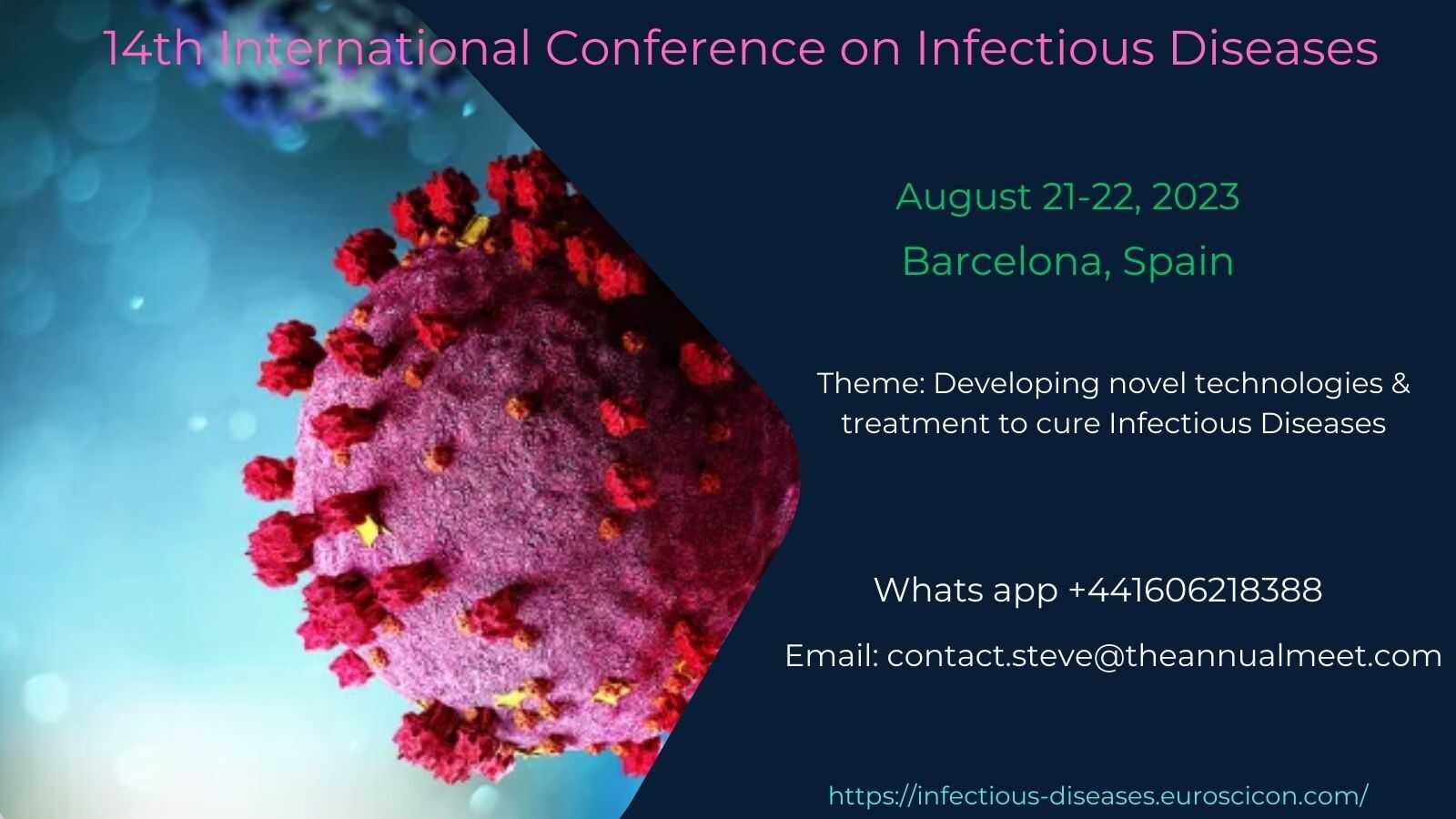
EuroSciCon Conferences invites all the participants from all over the world to attend “14th International Conference on Infectious Diseases” during August 21-22, 2023 in Barcelona, Spain, which includes prompt keynote presentations, special sessions, workshops, symposiums, oral talks, poster presentations and exhibitions.
lnfectious Diseases square measure disorders caused by organisms like microorganism, viruses, fungi or parasites. Infectious diseases is also of, food borne, vector borne, air borne in Related as further more in plants and animals. Infectious diseases essentially emphasize on the pathological process of the microorganism and their therapeutic measures, synthesize of branches of particularly clinical and diagnostic biology that deals with the cure hindrance of the Infectious diseases It represents associate degree progressively necessary for human morbidity and mortality reason throughout the globe. The Immunizing agent development may be nice importance’s in terms of world heal.
Target audience:
- Directors, Board Members, Presidents, Vice Presidents, Deans and Head of the Departments
- Infectious Diseases Researchers, Scientists, Faculties, Students
- Infectious Diseases Associations and Societies
- Medical Colleges
- Pharmaceutical Companies and Industries
- Medical Devices Manufacturing Companies
- Drug Manufacturing Companies and Industries
- Business Entrepreneurs and Industrialists
- Training Institutes
Why to attend?
Members from round the world centered on learning regarding infectious diseases and its advances in therapeutic and diagnostic market, this can be your best chance to achieve the biggest gathering of participants from the Infectious diseases community This direct conference conduct displays, distributes information, conducts conferences with current and potential scientists, build an article with new drug developments, and receive name recognition at this 2 days event. World well known speakers, the foremost recent therapeutic and diagnostic techniques, developments, and also the Novel technologies and therapeutic measures for infectious diseases resistance and management are hallmarks of this conference
Sessions and Tracks
SESSIONS/TRACKS
Track 1: Infectious Diseases
Infectious Diseases are mainly caused by micro-organisms like bacteria, viruses, fungi or parasites. some of these organisms cause diseases. Than any other cause infectious diseases kill more people throughout the world. These infections are mainly caused by germs .we can get infected by touching, eating, drinking or breathing something. Germs can also spread through animal and insect bites, sexual contact. Some of the diseases like measles and chickenpox can also be prevented by vaccines. Hand washing is also a used to prevent infectious diseases.

Track 2: Veterinary Infectious Diseases
These sciences are used to control human health through monitoring and control of zoonotic disease, infectious disease transmitted from non-human animals to humans, food safety, and indirectly through human applications from basic medical research food supply is through livestock health monitoring and treatment,and mental health by keeping pet’s healthy and long living.Veterinary scientists often collaborate with Epidemiologists.

Track 3: Pediatric Infectious Diseases
Pediatric infectious diseases are mainly infected in children; specialists are devoted for diagnosis and treatment of children who suffer from infectious diseases. These diseases are mainly caused by bacteria, viruses, fungi, and parasites and treat mild to most severe conditions. A wide range of and immunologic diseases caused by bacteria, viruses, fungi, and parasites. Pediatric specialist may also understand the unique signs, symptoms, treatments, and outcomes associated with infectious diseases in children.

Track 4: Respiratory and pulmonary Infectious Diseases
Chronic obstructive pulmonary disease and asthma are cause of respiratory symptoms. These affects the organs and tissues that make gas exchange possible in higher organisms, and includes conditions of the upper respiratory tract, trachea, bronchi, bronchioles, alveoli, and the nerves and muscles of breathing.

Track 5: Infection and immune system
Infection occupy organism's in body tissues by diseases causing agents, their reaction of host tissues to these organisms and toxins they produce must be sufficient number and virulence to destroy normal tissue, illness resulting from an infection. Infectious disease was also known as transmissible diseases or communicable disease, the immune system is a host defense system comprising many biological structures and processes within an organism that protects against diseases. An immune system identifies a variety of agents, like pathogens, from viruses to parasitic worms and distinguishes them from organism’s own healthy tissue.

Track 6: Zika /Ebola viruses
These virus spread was by Aedas mosquito. these viruses cause birth defects in babies by infected pregnant women, symptoms are mild fever, skin rash, conjunctivitis, muscle and joint pain, malaise or headache. These last for 2-7 days this infection was confirmed by laboratory tests on blood or other body fluids, such as urine, saliva or semen. Ebola virus disease (EVD), is commonly called as Ebola hemorrhagic fever (EHF) or Ebola, signs and symptoms typically start between two days and three weeks after contracting the virus with a fever, sore throat, muscular pain and headache then, vomiting, diarrhea and rash usually follow, along with decreased function of the liver and kidneys.

Track 7 : Infectious Diseases Epidemiology
Epidemiology suggests that examine the causes, pattern, and effects of health and diseases conditions in population. Characteristic the danger factors for being quality and targets for preventive care. The medical specialty infectious diseases are HIV/AIDS, malaria, infectious disease, pneumococcus drug-resistant infections.

Track 8: Diseases of reproductive organs and sexually transmitted diseases
A microorganism is rarely alone and once an outsized range of microorganism have gathered to create communities, supposed biofilms. They attach themselves to surfaces, they trigger severe, chronic inflammation, against that each the system and antibiotics area unit impotent. Bacterial pathogens, vibrio cholera are the molecular approaches.

Track 9 : Infectious/ Plant Disease Modelling
Plant pathology is that the study of diseases in plants caused by pathogens and environmental conditions. Organisms that cause infectious diseases embody fungi, oomycetes, bacteria, viruses, viroids, virus like organisms, phyto plasma, protozoa, nematodes and parasitic plants. Infectious disease of plant disease include, modeling of infectious diseases in plants. Medicine Dynamics of disease, epidemics, plant pathology.

Track 10: Immunology of Resistances
Immune system is a network of cells and chemicals. The cells within the system have the flexibility to acknowledge one thing as either self or extending the body system that protects the body from foreign substances, cells, and tissues by manufacturing the immunologic response which includes particularly the thymus, spleen, humor nodes, special deposits of animal tissue and lymphocytes together with the B cells and T cells.

Track 11: Vaccine and Vaccination
Vaccine produces immunity from disease and injected through Needle injections, through by mouth or aerosols. Vaccination is an injection of killed organism that produces immunity against that organism in body.

Track 12: Problems in Infectious Disease Practice
Infection Control in a health care facility is the prevention of the spread of microorganisms from one individual to another individual to prevent these infectious diseases problems frequent hand washing, infection out breaks, water and food in hospital must be maintained.

Track 13: Communicable/Non-Communicable diseases
Communicable diseases are spread from person to person or through animals .these can be spread through air and transfer from blood or other body fluids like malaria, HIV/AIDS. non communicable diseases are chronic diseases like heart diseases, cancer and diabetes.

Track 14 : Prevention of Methicillin-resistant S aureus (MRSA)
Methicillin-resistant S aureus(MRSA) is resistant to many antibiotics. Can also cause a variety of problems ranging from skin infections and sepsis to pneumonia to bloodstream infections. Skin infections and severe infections are mainly caused. Wearing gloves, hospitalization trends can mainly use for prevention of MRSA.

Track 15 : Diagnosis, Management and Treatment of Infectious diseases
Diagnosis for infectious diseases is laboratory tests, imaging scans, biopsies, and antibiotics, antifungals are given for treatment of infectious diseases.

Track 16: Vaccines/Preventive Vaccine for Infectious Diseases
Some common and preventable diseases diphtheria, Haemophilus influenza serotype infection, hepatitis B, measles, meningitis, mumps, pertussis, poliomyelitis, rubella, tetanus, tuberculosis, and yellow fever. Some of the vaccines for preventive infectious diseases are, Animal vaccines, cancer vaccines, influenza vaccines, etc.

Track 17: Preventing and Controlling Viral Hepatitis
To prevent and control viral hepatitis need to raise awareness of all types of viral hepatitis infections. Vaccines are also used to prevent and infectious precautions in health care and community settings, safer sex and hand washing, safe food and water provide protection against viral hepatitis.

Track 18: Infection Prevention and Control Guidelines
Patients are cared for in an environment that is safe and clean. . Every interaction in general practice should include a risk assessment of the potential for infection transmission. Hand hygiene, infectious prevention education and training, safe injection practices.

Track 19: Global Eradication of diseases
Eradication is that the reduction of infectious disease's prevalence within the international host population to zero. Smallpox and rinderpest are the diseases eradicated. Choice of infectious diseases for wipe-out depend on rigorous criteria.

Track 20 : Neurological Infectious Disease
The most challenging neurological disorders are viral and immune mediated disorders of the nervous system. The most common neuroimmune disorder is multiple sclerosis, and Meningitis is the most common viral infection of the nervous system, Nonepidemic viral infections constitute the majority of infections affecting the nervous system today. Chronic neurologic disease as a sequel to infection is a relatively new and developing area of both pediatric and adult neurology research. Chief among these disorders is the role of postinfectious brain inflammation in epileptogenesis.

Track 21: Blood Infectious Diseases
Germs can cause infection in human blood and diseases are known as blood borne pathogens. The most common and dangerous germs spread through blood within the hospital are viral hepatitis B and hepatitis c virus. These viruses cause infections and liver injury. This virus cause AIDS. Organisms such as bacteria, viruses, prions, and parasites will be transmitted through blood transfusions.

Track 22: Acute Rheumatic Fever/Rheumatic Heart Disease
Acute rheumatic fever is an autoimmune inflammatory develops as a sequel of streptococcal infection .Acute rheumatic fever is the result of an autoimmune response to pharyngitis caused by infection with group A Streptococcus. The long term damage to cardiac valves caused by ARF, which can result from a single severe episode or from multiple recurrent episodes of the illness, is known as rheumatic heart disease.

Track 23: Infectious Diseases Pathology
The pathogenesis of bacterial infection includes initiation of the infectious process and the mechanisms that lead to the development of signs and symptoms of disease. Bacterial infections can involve different compartments of the CNS, leading to different clinical and pathologic manifestations.

Market Analysis
MARKET ANALYSIS
Importance and scope:
Infectious diseases are worldwide leading explanation for death; a number of the communicable disease was in high causes of death in globally in most up-to-date survey by World health organization. Infectious diseases have cause damage to humans throughout history. Infectious diseases are especially listed by infectious diseases specialist .infectious diseases that replicate a worldwide or produce aerosols generated to be decreased. Healthcare personnel read on burden and diseases. Health care personnel may get to take extra infection management steps taken to stop these infectious diseases in patients. Health care personnel will be exposed to ebola virus by touching a patient’s body fluids, contaminated medical supply and equipment’s, or contaminated environmental surfaces. Splashes to unprotected mucous membranes (for example, the eyes, nose, or mouth) are risk. Procedures that may increase environmental contamination with infectious material or produce aerosols generated or decreased. healthcare personnel unpaid, operating in aid settings World Health Organization have the potential for exposure to patients and infectious diseases, together with body substances, contaminated medical supplies and equipments, contaminated environmental surfaces, or aerosols generated throughout medical procedures. Health care personnel’s include, however aren’t restricted to, physicians, nurses, pharmacists laboratory personnel, students and trainees.
Why Barcelona :
Barcelona is a city on the coast of northeastern Spain. It is the capital and largest city of the autonomous community of Catalonia, as well as the second most populous municipality of Spain. With a population of 1.6 million within city limits, its urban area extends to numerous neighbouring municipalities within the Province of Barcelona and is home to around 4.8 million people, making it the fifth most populous urban area in the European Union after Paris, the Ruhr area, Madrid, and Milan. It is one of the largest metropolises on the Mediterranean Sea, located on the coast between the mouths of the rivers Llobregat and Besòs, and bounded to the west by the Serra de Collserola mountain range, the tallest peak of which is 512 metres (1,680 feet) high.
Founded as a Roman city, in the Middle Ages Barcelona became the capital of the County of Barcelona. After joining with the Kingdom of Aragon to form the confederation of the Crown of Aragon, Barcelona, which continued to be the capital of the Principality of Catalonia, became the most important city in the Crown of Aragon and the main economic and administrative centre of the Crown, only to be overtaken by Valencia, wrested from Arab domination by the Catalans, shortly before the dynastic union between the Crown of Castile and the Crown of Aragon in 1492. Barcelona has a rich cultural heritage and is today an important cultural centre and a major tourist destination. Particularly renowned are the architectural works of Antoni Gaudí and Lluís Domènech i Montaner, which have been designated UNESCO World Heritage Sites. The city is home to two of the most prestigious universities in Spain: the University of Barcelona and Pompeu Fabra University. The headquarters of the Union for the Mediterranean are located in Barcelona. The city is known for hosting the 1992 Summer Olympics as well as world-class conferences and expositions and also many international sport tournaments.
Barcelona is a major cultural, economic, and financial centre in southwestern Europe, as well as the main biotech hub in Spain. As a leading world city, Barcelona's influence in global socio-economic affairs qualifies it for global city status
Barcelona is a transport hub, with the Port of Barcelona being one of Europe's principal seaports and busiest European passenger port, an international airport, Barcelona–El Prat Airport, which handles over 50 million passengers per year, an extensive motorway network, and a high-speed rail line with a link to France and the rest of Europe.
Universities related to Infectious Diseases:
- University of Cambridge
- Kings College of London
- London School of Hygiene and Tropical Medicine
- Imperial College London
- UCL Institute of Epidemiology and Health care
- University of Sheffield
- Pediatric Infectious Diseases Society
- Columbia University
- University of Maryland
- Swedish Institute for Infectious Disease Control
- Uppsala University
- University of Gothenburg
- University of Otego
- Oslo University
- University of Pittsburgh
- Emory Health Sciences
- Queensland University of Technology
- University of Liverpool
- University of Colorado Denver
- Infectious Diseases Society of America
- Medical College of Georgia at Georgia Regents University
Market analysis for infectious diseases:
Infectious diseases are the second leading cause of death worldwide, according to current estimates of the World Health Organization (WHO), the leading killers of children under five years of age. In spite of tremendous progress made in the Different Countries during the 20th century in reducing infectious disease deaths. when aggregated, such deaths rank third behind cardiovascular disease and cancer in this country. With more than 1 billion humans crossing international borders in 2013. This market is expected to increase at a compound annual growth rate (CAGR) of 8.8% to reach $138 billion in 2014. The largest market share belongs to antibiotic treatments for bacterial and fungal diseases at 53% of the total infectious disease treatment market. In 2015, 6.5 million individuals were infected with Human Immunodeficiency Virus (HIV) and 28% of the HIV infected people were accessing antiretroviral therapy. Moreover, increasing availability of counterfeit drugs is expected to pose significant threat to the market during the forecast period. The global infectious disease therapeutics market size was valued at $ 46.88 billion in 2016 and is projected to grow at a CAGR of 6.6% during the forecast period. The Infectious disease diagnostic (IDD) market is estimated to grow at a CAGR of 7.9% to reach $18,156.2 million by 2019.
We live on a crowded and interconnected planet, with a projected global human population of at least 9 billion by 2050. The urbanization of the human population is impacting the risk of transmission of many infectious agents. Currently, more than 80 % of humans live in developing countries, Rising prevalence of infectious ailments, increasing expenditure to boost the penetration rate of treatments of these diseases, rising initiatives for creating awareness about treatments & diagnosis of these conditions, and increasing clinical trial studies for development of new drugs are likely to be the factors responsible for growth of this market. However, lack of awareness about treatments for these disorders and low adoption of treatments are factors expected to restraint the growth in the coming years.
Association Related to Infectious Diseases
- International Society for Neglected Tropical Diseases
- Italian Society for Infectious and Tropical Diseases
- Infectious Diseases Society of America
- British Infection Association
- European Society of Clinical Microbiology and Infectious Diseases
- European Society for Pediatric Infectious Diseases
- Bart’s and The London Societies
- International Society for Infectious Diseases
- Australasian Society for Infectious Diseases
- Clinical Infectious Disease Society
- Hong Kong Society for Infectious Diseases
- Texas Infectious Disease Society
- Connecticut Infectious Disease Society
- Armed Forces Infectious Diseases Society
- Vanderbilt Infectious Diseases Society
- Swiss Society for Infectious Diseases
- ID Society of St. Louis
- Infectious Diseases Society of Ireland
- World Health Organization
- Society for Infectious Diseases Pharmacists
- International Society for Infectious Diseases
- World Health Organization
- Worldwide societies for infectious diseases
- National Infection Institute
Learn more
LEARN MORE
Global Top Infectious Diseases Universities
Augusta University |Wayne State University|Penn University|University of Maryland | Drexel University | EurosciconConferences | University Of Miami | University of Georgia | Harvard University|WashingtonUniversity| University of Illinois|University of Minnesota | University of Charleston | West Virginia University|University of Wisconsin | University of Wisconsin | University of Washington | EuroSciCon | University of Appalachia | Duke University | University of California | University of Melbourne | University of Toronto | EuroSciCon | University of Pennsylvania | Cornell University | Yale University | University of Michiga | Washington University in St Louis | McGill University | University of North Carolina at Chapel Hill | Boston University | McMaster University | EurosciconConferences | University of California | Northwestern University | University of British Columbia | University of Pittsburgh | New York University | Emory University | Vanderbilt University | Case Western Reserve University | University of Southern California | EurosciconConferences | Tufts University | Dartmouth College | University of California, Davis | University of Wisconsin-Madison | Ohio State University | University of Virginia | University of Florida
European Infectious Diseases Universities
University of Oxford | University of Cambridge | University of Copenhagen | University College London | Imperial College London | Swiss Federal Institute of Technology Zurich | University of Zurich | Karolinska Institute | University of Munich | University of Edinburgh | Pierre and Marie Curie University | Heidelberg University | University of Manchester | Catholic University of Leuven | University of Helsinki | Freie Universität Berlin| Utrecht University | Uppsala University | Wageningen University and Research Center | EuroSciCon
Humboldt-Universität zu Berlin | University of Groningen | University of Barcelona | Technical University of Munich | Leiden University | University of Basel | University of Strasbourg | Ghent University | King's College London | University of Geneva | EurosciconConferences | University of Dundee | Lund University University of Göttingen | University of Freiburg | Stockholm University | University of Gothenburg | University of Sheffield | Eberhard Karls University, Tübingen | University of Padua | University of Würzburg | Université Paris-Sud | EuroSciCon | University of Vienna | University of Bristol | Free University of Brussels | University of Milan | University of Amsterdam | University of Nottingham | University of Hamburg | University of Oslo | University of Leeds | University of Birmingham | University of Southampton | University of Bern | University of Cologne | Medical University of Vienna | University of Münster | University of Lisbon | University College Dublin | University of Aberdeen | University of Liverpool | Euroscicon Conferences | Trinity College Dublin | Delft University of Technology | Bielefeld University | University of Leipzig | Cardiff University | University of York | University of Regensburg | University of Warsaw
University of Tokyo | National University of Singapore | Kyoto University | Peking University | Tsinghua University | Weizmann Institute of Science | Osaka University | Seoul National University | Shanghai Jiao Tong University | Fudan University | Zhejiang University | EurosciconConferences | Tel Aviv University | Hebrew University of Jerusalem | University of Hong Kong | Tohoku University | Nanyang Technological University | Korea Advanced Institute of Science and Technology | Hokkaido University | National Taiwan University | Keio University | Shandong University | Nagoya University | Sungkyunkwan University | Yonsei University | Kyushu University | Sun Yat-sen University | Huazhong University of Science and Technology | Wuhan University | University of Science and Technology of China | EuroSciCon | Tokyo Institute of Technology | Tokyo Institute of Technology | EurosciconConferences | King Abdulaziz University | National Cheng Kung University | Kobe University | Korea University | Pohang University of Science and Technology | EuroSciCon Conferences | Indian Institute of Science | Nankai University | EuroSciCon | Tongji University | King Saud University | Nanjing University | Harbin Institute of Technology | University of Tsukuba | Kyung Hee University | Sichuan University| Xiamen University | Chonnam National University | Jilin University | Central South University | University of Tehran | Aligarh Muslim University | Chinese University Hong Kong | University of Delhi | South China University of Technology | EuroSciCon | Waseda University | Okayama University | Southeast University | Soochow University | Mahidol University | Hiroshima University | Tianjin Medical University | Kanazawa University | Tehran University of Medical Sciences | Kumamoto University | EurosciconConferences | Kyungpook National University | National Yang-Ming University | China Medical University
Related Conferences to Infectious Diseases
Infectious Diseases Conferences | Infection Meetings | Infectious Diseases Conferences 2018 | Euro Infectious diseases 2018
12th Edition of International Conference on Infectious Diseases, Rome, Italy, April 22-23, 2018 | 6th International Congress on Infectious Diseases Feb 25-26, 2019 London, United Kingdom | 10thEuro-Global Conference on Infectious Diseases ,September 27-29, 2018 Rome, Italy | 4th International Conference on Influenza and Zoonotic Diseases July 2-3, 2018 Vienna, Austria | 9th Emerging Infectious Diseases Conferences, 31st August-1st September 2018 Zurich, Switzerland | Euroscicon Conferences | 10th Virology Conferences July 2-4, 2018 Vienna, Austria. | Microbialphysiology Conferences July 16-18, 2018 London, UK | 7th Microbiology Research Conferences, August 13-14, 2018, Madrid, Spain | EuroSciCon | 23rd Immunology and Evolution of Infectious Diseases , April 29-30, 2019, London, UK, 2ndInfectious diseases and STD-AIDS , April 15-16 2019 , Paris, France
Infectious Diseases Related Research Units
Infectious Diseases Clinical Research Unit (CRU) | Alfred Health| NYU-Emory Tuberculosis Research Unit | Infectious Diseases Research | Children's Hospital of Pittsburgh| Infectious Diseases Research Unit - - Lund University| Infectious Diseases​​​ - Stellenbosch University| ICDC Unit| NIH Guide| Health Environment & Infection Research Unit (HEIRU)| Swiss TPH| Infectious Diseases Unit – California National Primate Research Center |Victorian Infectious Diseases Service (VIDS)| EuroSciCon | National Institute of Allergy and Infectious Diseases, NIH| Infectious Diseases - oahpp.ca| World Health Organization| Infectious Disease Research Institute: IDRI| Euroscicon Conferences Infectious Diseases Research | Ohio State Medical Center| Infectious disease urmc| Stanley Ho Centre for Emerging Infectious Diseases (CEID)| Cochrane Infectious Diseases Group | LSTM| Q research|Emerging Infectious Disease journal – CDC
Infectious Diseases Job Opportunities
Infectious Research Scientist – Microbiology Dyson | EuroSciCon | Research Microbiologist Lonza | Euroscicon Conferences | Food Safety Microbiological Specialist Britvic Soft Drinks Ltd | Johnson & Johnson Family of Companies | Postdoctoral Research Associate in Infectious Diseases Fermentation University of Reading , PhD Studentship: Antimicrobials & Antimicrobial Resistance University of Nottingham | Senior scientists, antibody discovery and protein engineering | Microbiologist - Environmental Monitoring | QC analyst – Microbiology Liverpool, England | Equipment Management Associate - Harrogate, UK | Senior Biomedical Scientist (Microbiology) England | Microbiology Laboratory Technician South East | Technical Manger - Microbiology- Water Testing - SE London | [Microbiologist/Biochemist] Plate Coating Scientist (Microtiter) | Microbiologist - Environmental Monitoring | PhD / Senior Microbiologist for Science Solutions Recruitment Ltd | Microbiology Technical Specialist - Home Based | Microbiology Lab Manager for Chain Biotech | Senior Microbiologist in Dun Laoghaire Infectious Diseases Manager Vivid Resourcing London | Microbiology - Associate Director Pharmaceutical Industry London | Euroscicon Conferences | Microbiology Technician for Clinical Professionals UK | Plant Microbiologist Cork, Ireland | EuroSciCon | Senior Microbiologist (Team Leader) ABERDEEN - United Kingdom | QC Micro Analyst Scotland, UK | Research Scientist - Microbiologist Supervisor New Brunswick, NJ, USA | Sr Microbiologist Danvers, MA United States | QC/QA Microbiologist cheshire, Manchester, North West England | Microbiologist Matchtech East Riding of Yorkshire , England.